Hakone to Kyoto via Odawara: How to Plan Your Train Journey
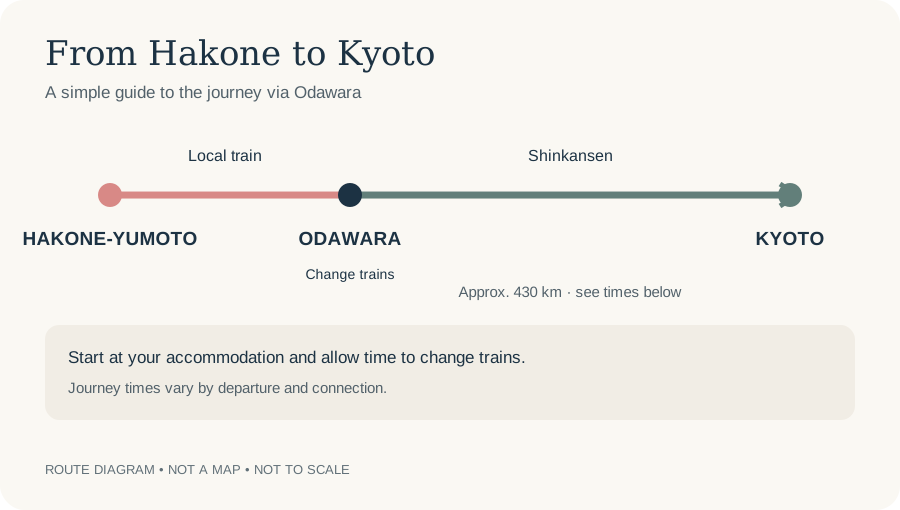
The Odawara–Kyoto Shinkansen journey covers approximately 430 km by rail. As a planning example, direct trains shown in a past timetable took roughly 1 hour 45 minutes to 3 hours; departure times and journey durations vary. Add the journey from your accommodation to Odawara and allow time to change trains. Check your travel date before booking. Route distance (Japanese), October 2026 timetable example (Japanese)
If you are leaving Hakone for Kyoto, start by looking for a Shinkansen journey from Odawara to Kyoto. You do not need to return to Tokyo. From the Hakone-Yumoto side of Hakone, Odawara is the station where your local journey connects with the Tokaido Shinkansen. Hakone Tourist Association access guide
The useful question is not simply which train is fastest. It is which departure you can comfortably reach after breakfast, checkout and the trip down from your accommodation.
Our suggestion: check direct services first, then compare connecting journeys if the direct options do not fit your day. This guide is based on official information checked on November 8, 2026, rather than firsthand travel experience. Exact times, fares and availability depend on your travel date.
Start with your accommodation, not just “Hakone”

Photo: Guilhem Vellut / Wikimedia Commons, CC BY 2.0. Unmodified.

“Hakone to Kyoto” describes a journey between regions. Your booking search needs actual stations.
For a stay near Hakone-Yumoto, plan the local leg to Odawara, then the Shinkansen leg to Kyoto. If you are staying farther into Hakone, add the journey from your accommodation to that route. The official Hakone transport map helps you identify which train or bus you need. Hakone transport map
Write your plan as three separate parts:
- Accommodation → Odawara Station.
- Time at Odawara to find your way, deal with tickets and reach the platform.
- Odawara → Kyoto, followed by the journey to your Kyoto accommodation.
This article focuses on the Odawara route. If your hotel recommends a different gateway, compare the whole journey from its location before booking.
Look for a direct Hikari first

Hikari service at Tokyo Station in 2017. Photo: Pundit / Wikimedia Commons, CC BY-SA 4.0. Unmodified.

Hikari trains have different stopping patterns, so the train name alone is not enough: your chosen service must stop at Odawara and continue to Kyoto. Kodama is the all-stations service; check its destination and whether the journey shown is direct. Nozomi trains do not stop at Odawara. Use the operator's timetable and your dated booking results to check the specific service. JR Central timetable, official train types and stopping patterns
For this journey, a direct Hikari is a sensible first search because it combines fewer stops with no Shinkansen change. That is a planning recommendation, not a claim that every Hikari departure is the best option.
| Option shown in your search | What to compare |
|---|---|
| Direct Hikari | Can you reach its Odawara departure without rushing? |
| Direct Kodama | Does the arrival time fit your Kyoto plans? |
| Journey with a Shinkansen change | Is the earlier arrival worth another transfer with your luggage? |
Compare arrival times, not just departure times. A train leaving first does not necessarily get you there first. JR Central also notes that its published basic timetable does not include every train, so use a date-specific search for the final decision. JR Central timetable notes
How to compare journeys in SmartEX
SmartEX is an official reservation service for the Tokaido, Sanyo and Kyushu Shinkansen. Its reservation guide provides a “Search only Direct Trains” option. Enter Odawara as the departure station, Kyoto as the arrival station, and your travel date and passenger details. Search direct journeys first; then repeat without that restriction if you want to compare connections. SmartEX reservation instructions
Before paying, check the arrival time, any transfer, seat choice, total price and ticket conditions. If a connection appears, examine both trains rather than assuming the entire journey has the same seating arrangement. SmartEX's guide notes that connecting services can have different facilities or seat arrangements. SmartEX reservation instructions
This guide does not quote a single fare for every departure. Use the price offered for your date and selected ticket, and read its change and refund conditions before purchasing. We have not checked live inventory or a bookable fare for your journey.
Your Hakone Freepass does not take you to Kyoto
The Hakone Freepass covers specified transport in the Hakone area. The Shinjuku version also includes the specified Odakyu round trip between Shinjuku and Odawara. It does not cover the Shinkansen from Odawara to Kyoto; arrange that journey separately. Official Hakone Freepass coverage
If your pass is still valid and your local journey uses a covered service, it may cover your return toward Odawara. Check the validity period and route instead of assuming every bus or train is included.
Still choosing your pass for a Tokyo–Hakone–Kyoto trip? Our Hakone Freepass comparison explains how onward travel changes the comparison between the Shinjuku and Odawara versions.
Give the Odawara transfer its own place in the plan
At Odawara, follow signs for the Shinkansen and check your departure on the station display. JR Central publishes an Odawara station map showing the layout. Reviewing it before arrival can make the transfer easier to understand. Official Odawara station map
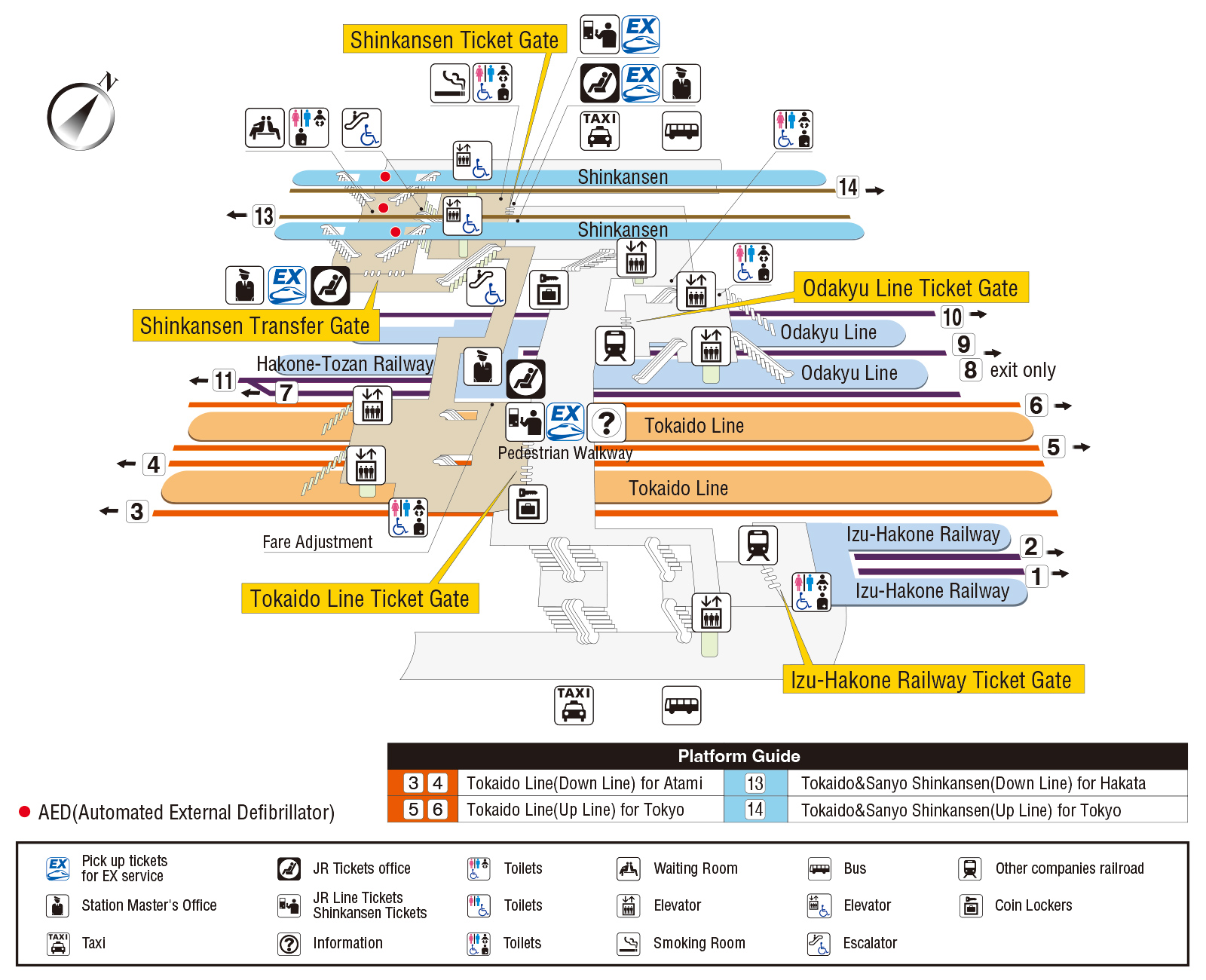
We suggest leaving breathing room between your planned local arrival and the Shinkansen departure. The right margin depends on whether you already have usable tickets, need assistance, are traveling with children, or have luggage to manage. This is practical planning advice, not an operator's minimum connection time or a guarantee against delays.
Treat a lunch purchase or ticket pickup as part of that margin. Neither happens while you are walking toward the platform.
Measure a large suitcase before choosing seats
On this Shinkansen route, ordinary baggage whose three dimensions total more than 160 cm and no more than 250 cm requires a seat with an oversized baggage area. Ordinary baggage exceeding 250 cm is not permitted. Some items such as strollers and musical instruments have exceptions, but using an oversized baggage area still requires a reservation. Other size, weight and quantity limits also apply. Measure your suitcase before booking and check the rules for your belongings. JR Central oversized baggage guidance
There is a potentially confusing distinction: the trial luggage storage areas on some decks, introduced in July 2025, do not remove the reservation requirement for oversized baggage. If your bag falls into that category, follow the seat-reservation rule. SmartEX luggage-storage trial notice
If you are considering sending a bag ahead, confirm the receiving hotel's policy and the delivery service's timing first. Do not build your Kyoto arrival plans around an unconfirmed same-day delivery.
A simple way to choose your departure

Photo: Guilhem Vellut / Wikimedia Commons, CC BY 2.0. Unmodified.

Start with the time you want to arrive in Kyoto, then work backward. Include the journey from Kyoto Station to your hotel, especially if you have a fixed check-in arrangement or dinner reservation.
Next, compare the Shinkansen options from Odawara. Pick a departure that leaves enough time for your actual Hakone checkout and local journey. If the direct train you prefer makes the morning feel rushed, compare a later departure or a connecting route rather than treating one train as essential.
Before the day of travel, have these details ready:
- Your route from the accommodation to Odawara.
- Your train departure, arrival and any connection.
- Your boarding method and any ticket pickup needed.
- Your seat and luggage arrangements.
- The route from Kyoto Station to your next accommodation.
The aim is a journey that works from one hotel door to the next. Once those pieces fit, you can enjoy your last morning in Hakone without repeatedly checking the clock.